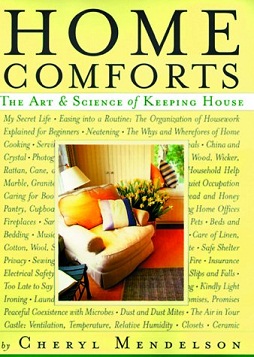
 My old college chum Alicia introduced me to Cheryl Medelson this fall, and I was so impressed with this book that I bought half a dozen copies for Christmas presents. Home Comforts is like having your mom and grandma write down all the housekeeping tips they never told you or told you but you forgot. The author is a lawyer (!) who loves to keep house. Not in a Martha Stewart artsy way (because my house is never going to be like that–I don’t have that gifting), but in a practical, this-is-why-we-do-things-this-way way. She explains the basic science behind cleaning and safety procedures, gives sample routines for keeping your stuff nicer for long, and inspires readers to think of housework as a means to making your home, well, more homey. And it’s scintillating reading.
Keeping house, Mendelson explains, is a lost art. With the “liberation” of the 60s and 70s came a whole generation who was never taught how to keep an organized, clean house. Burning bras took precedence over the art of laundering delicates. And even if women stayed home with their kids in the 80s and 90s, many of them lost the explanations behind the housekeeping habits that their mothers or grandmothers had. I grew up never airing my bed because I honestly had no idea why my grandma did it. Now I know that fresh air fights the growth of dust mites (which make us sicker and break down our mattresses and pillows faster with their waste and dead bodies). In almost every chapter, I felt like I had an aha! moment that just helped explain to me some aspect of homemaking that had me confused, frustrated, or disgusted. One of the best topics of an early chapter is “neatening,” the habit of putting things away whereby you never let your house explode out of control. When you’re done eating, put your dishes directly into the dishwasher. The extra step of sitting in the sink or the counter is needlessly overwhelming to a tired mommy at the end of a long day. (I don’t seem to remember that the author has a dishwasher in her tiny NY apartment–I’m applying her principles to our own lifestyle.) When you’re done reading a book, put it back on its place on the shelf. If you’re still reading a book, leave it out–projects in process are part of what makes your home homey and lived-in–but have a place for it (end table, etc). At the end of the day, make the kids pick up their toys and put them away so that you’ll start the morning with a clear living room floor. Get the idea? Now that we have our small group here every week, I feel the pressure to have the home picked up. But if Derek and I have been good about neatening as we go throughout the week, I don’t have to spend hours on Wednesday in a panic hiding piles of stuff in a laundry basket in my bedroom.
There could be two pretty opposite responses to this book. One person could read it and feel overwhelmed by the seemingly unachievable standard she gives. Looks like negative amazon reviews are saying that. Or another person can love it as a reference and as inspiration for how to make keeping house more streamlined and consistent. I’m in the latter camp! For those who are overwhelmed and have this picture of the author dragging her beds outside into the sunshine every afternoon and hand bleaching the counters every evening, I have to admit that I used to think that about clean houses, too. Derek’s mom is an excellent housekeeper, and I definitely felt out of place the first couple times I visited the Mullers because everything had a place and I was afraid to put a towel or pillow in the wrong place! I have to laugh now because I am extremely comfortable there, partially because I know where everything goes, and because there’s not clutter or chaos stressing me out. I think I’ve become more of an everything-in-its-place person about toys than my in-laws! Now a really messy house is oppressive and stressful and a clean house is welcoming and relaxing. I also don’t feel obliged to do everything on Mendelson’s list right now. And while my house is generally picked up, I still panic before Bible study to get things really picked up and cleaned. But I’m trying to incorporate one of her tips into my routines each month. I’ve started washing all bedding in hot water (to kill things living in it–warm water does nothing, so if you’re afraid to wash in hot, you might as well do cold), airing our beds (pulling the covers down when we get up and making them when we come up to get dressed after breakfast), filling my washer up with water before I add the clothes to let the detergent dissolve better (I’ll switch stuff to the dryer and clean out the lint trap while I wait to add clothes to the washer), doing my chores on a weekly schedule (especially limiting laundry to two days a week–extremely freeing for me because if I don’t get the dress shirts done on Mon, I’ll start with them on Thurs but don’t spend every other day wondering if there’s stuff I need to put in the dryer), and running the dishwasher every night and unloading it first thing in the morning (because I’ve trained Tommy to put his dishes right in the dishwasher now, so it has to be unloaded by the end of breakfast!). That last one is my big project for Feb, in fact, so feel free to ask me if I’ve unloaded my dishwasher today! I figure that I can spend a month working on each new habit, so it won’t be overwhelming, but in 5 years, I’ll have 60 new and better housekeeping habits.
I highly recommend this book!
I am going to check this out from the library! Thanks for the recommendation.