First in an occasional series.
People often ask us about board games. Not that we’re particular experts, but because we have our ear to the ground in gaming circles. We branch out beyond Monopoly and Clue to European hits and intricate commodities-gathering. We have our favorite stores, including Griffon Books in South Bend, Ind., and Valhalla’s Gate in Columbia, Mo.
People often ask us about games that are good for friends and family: games that don’t require lengthy instructions, intense strategy, or tiresome gameplay for a novice. These games work well with various, often larger, numbers of people, and each can be played in less than an hour (which permits time for another game if the family enjoys it and wants to try again “now that we get it”). Here are the (i.e., my) top four casual games for friends and family, from all categories of games–“serious,” standard, and party (in no particular order).
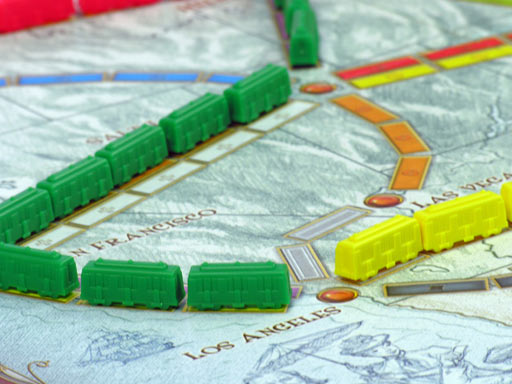 Ticket to Ride
Days of Wonder
2-5 players
30-60 minutes
Collect train cars and complete routes across North America circa 1900. This low-maintenance game has only three possible actions you can perform on your turn, and you’ll generally only choose between two of them. It’s not terribly cut-throat, unless a route you’d like is suddenly taken or placed in danger by a competitor. Scoring may be a forgettable endeavor, but first-timers often win. (Purchasing tip: if a close friend owns Ticket to Ride, try Ticket to Ride Europe for some variety.)
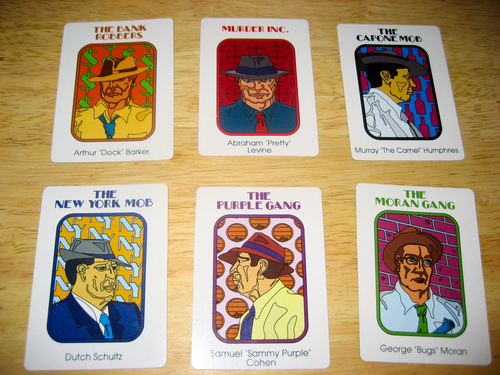 Family Business
Mayfair Games
3-6 players
45-60 minutes
Protect your mafia’s family members while killing everyone else’s. This quick-play game of murder and intrigue is always a big hit, particularly with a large crowd; the closer to a full six players, the better. Explaining game play takes just a few minutes (even with many kinds of action cards), and, after a couple of times around, new players dive right into vengeance and payback. Plus, there’s enough luck to ensure that a new player can defeat a veteran any given day. (Purchasing tip: the second generation of Family Business has authentic portraits of mobsters, a much more compact box, and a new card or two. We own the first generation, pictured here, which has generic portraits of mobsters, a large box, and the “original” deck.)
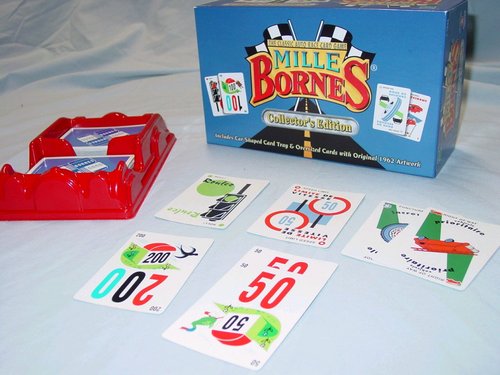 Mille Bornes
Hasbro
2, 3, 4, or 6 players
30-60 minutes
This French racing game debuted in 1962. It might be a household name where you’re from, but for a lot of folks it’s not on the same shelf as Scrabble or Monopoly. This turn-based draw-and-play card game requires you (or your team) to race to 1000 miles before your opponent (or opposing team) does. Sure, it’s mostly luck, but it’s always been an enjoyable game to have around because of the speedy gameplay and enjoyable competition. Easy to learn, easy to score, and easy to make a comeback at the last minute. And family members always enjoy revenge in the form of an out of gas card, an accident, or a coup-fourré. The flexibility of gameplay is also a great feature: you can play one-on-one, one-on-one-on-one, two-on-two, or two-on-two-on-two. (Purchasing tip: splurge for the “Collector’s Edition,” which includes the original 60s artwork.)
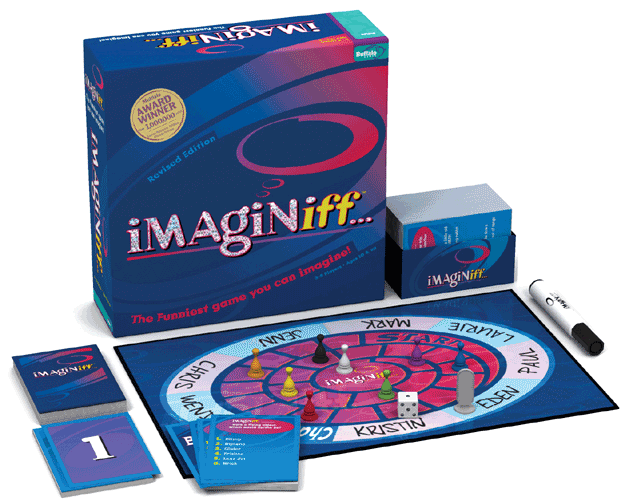 iMAgiNiff
Buffalo Games
45-60 minutes
3-8 players
Sometimes, you want a game as intense as Taboo with the humor of Apples to Apples. Except that Taboo requires too much thinking and, well, Apples to Apples gets tiring if people always pick the “Hillary Clinton” card and you’re stuck with “fuzz.” iMAgiNiff is best with a group of eight people who know each other quite well. You roll and take turns picking one of your group to be the object of a question: if Emily were a computer part, could meet a famous dead person, were a color; and there are six answers. Everyone votes, and everyone who votes for the majority gets to advance. You can also have a “challenge,” where you try to match the same answer as someone else. Hearing how people explain their answers leads to the best conversation topics and laughter of the night.
The next topic in this series will discuss how to enter the “serious gamer” market in four easy steps.
Oh, I hate Mille Borne! I don’t know why. I’ve only played it once, but for some reason, it and I didn’t agree!
Never tried imaginiff…looks interesting!
You must not have played with the right hostile family members!
HA HA HA
Are we going to play Family Business this weekend? Imaginiff sounds like it would be good with our crowd as well.
Most importantly, how are Tommy’s Family Business skills coming along?
Oh, we’ll definitely have to get out Imaginiff–it’s sortof like the conversations we had in Mauck, anyway!
Just need to print a correction re: Family Business. What you refer to as the First and Second editions are actually Second and Third editions. And it may be important to some that the Second edition has the ever-crucial reminder text on all cards, whereas the Third edition has a color-coding scheme.