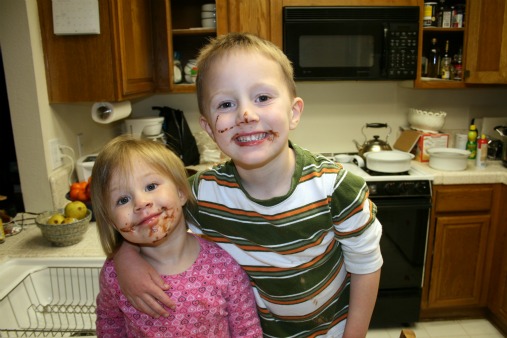
Recently, I’ve been reading a ton of light reading while running on the treadmill. I tried G K Chesterton and T S Eliot on my nook, but honestly, if I’m running, it’s got to be fluffier So I have a ton of material to think on and discuss below the break with the three or so of you who are remotely interested in the topic.=) The rest of you can just enjoy the unrelated cute picture of the kids licking the bowl for chocolate brownie pudding.
I’ve said in the past that I don’t like YA fiction. Here’s why–in my mind, it’s epitomized by Twilight and worse. Angsty teens, (almost) sex and lying to parents, melodramatic plots, very poor writing. I think I’ve mostly assumed that we should stick to great children’s literature, which tends to focus on less mature themes (or, like Lewis, handle them in a more kid-friendly way), then skip to engaging grown-up fiction (like Lord of the Rings) once the kids are ready for death and violence. But my crash course in YA fantasy has me admitting that there may be a place for the in between stuff.
- I’ll start with my favorite new discovery–The Wingfeather Saga, a series by Christian singer/songwriter/author Andew Peterson.
Content: Three children live with their mother and ex-pirate grandpa in a magical kingdom conquered by evil Fangs. Over the course of the series, they learn the truth about themselves and the father they never knew, fight bad guys, go on adventures, and learn a lot about redemption and grace. Heavily influenced by Prydain, Narnia, and Middle-Earth, Andrew Peterson’s fantasy world isn’t overtly Christian, but he is all about “Truth with a capital T.” Because his imaginary world is fallen, just like ours, bad and scary things happen. I won’t be reading this one to the kids for several years because I know they’re too sensitive right now. For those who might be concerned, Peterson has a great note to parents that explains his motivations for writing. I think this is a good argument for having an official genre in between children’s and adult fiction.
Artistic Quality: Here’s my quandry. The writing, especially in the first book of the series, is not quite first rate. The plot, imagination, and characters are engaging, but the descriptions sometimes veer into immaturity. I get the sense that some of the pre-teen boy humor (eg, gross-out details about the bad guys–They eat toenail clippings and maggots! They smell like the outhouse! Haha!) totally cracked the Peterson family up around the dinner table while Dad was writing, but it distracts from what I quickly found is a richer story. I do think Peterson sobers up as the series continues, and I found that details I originally found silly (“the Nameless Fear Named Gnag”) take on a much deeper significance. I want my kids to read works of literary AND moral excellence–and this isn’t in the same class as Lewis or Tolkien. But it’s also compelling, theologically deep without being moralistic, and still better written than most of the contents of the YA section (admittedly not a high standard!). The third book brought me to tears, and I can’t wait for the fourth and final installment, scheduled for next year.
- Another new discovery that I liked (with reservations) is the Percy Jackson series by Rick Riordan.
Content: It’s been described as Harry Potter meets Greek myths–modern day kids discover that they are actually demigods, the offspring of the Greek gods and mortals. In each adventure, Greek (and later, Roman) myths take on a modern spin, as Percy (the son of Poseidon, who now appears in Bermuda shorts and surfer hair) and his friends encounter familiar villains in contemporary settings: Medusa now has a landscape gardening business (she’s good at creating realistic stone art); the Amazons run amazon.com, wield warrior forklifts, and plan to conquer the world economically–you get the idea. Coming in with low expectations, I was surprised to see how much I enjoyed all the mythical references. I can see how parents might be concerned that fun stories of mythical gods might confuse their kids with relation to the real God. However, when our kids are ready, I think the books will provide a great starting point for comparisons of Christianity with other faith systems. Despite the fun and the adventures, Percy’s world is fatalistic. There are no adult demigods because they never live that long–eventually, they will all meet a monster they can’t defeat. Their divine parents are limited by fate and can’t help them most of the time. True to the ancient tales, the gods of Olympus are very flawed–arrogant, self-absorbed, selfish, and sometimes, just nasty. Percy and his friends act heroically, and they learn to be patient, kind, brave, and humble. But their tales pale in comparison to the story of a God who loved His creation so much that He sent His Son to die to save them.
Artistic Quality: The first series is told in first person, a style I don’t particularly care for. You can tell that Riordan was a middle school teacher–Percy’s thoughts and actions line up pretty well with how I think a 12 year old boy would think. Setting my own preferences aside, I’d say that Riordan does have a better grasp on the English language than, say, Stephanie Meyer. I’d probably compare him to a concise JK Rowling, though the flavor of the books is so American that it’s hard for me to do a direct comparison. I enjoyed the pace, wanted to know what would happen next, and cared about the main characters. With that said, though, I wouldn’t call it sophisticated prose. I’ll probably relegate it to the relatively-harmless-series-for-voracious-readers shelf and recommend it after Tommy has blazed through better fantasy like Narnia, Prydain, and Wingfeathers.
- I joined a book club this spring, and last month’s choice was Peter and the Starcatchers, by Dave Barry (yeah, the newspaper humor guy) and Ridley Pearson.
Content: This series is a big prequel to Peter Pan, though with so many strange additions that the wonder of the Barrie version is definitely lost in the details. Peter’s flying abilities, the creation of Tinkerbell, and the strange conglomeration of creatures, pirates, natives, and mermaids in Neverland are all due to starstuff, a magical essence from falling stars. Peter and his friend Molly are caught in an epic battle of good and evil as Starcatchers try to return starstuff to the heavens and the Others use it for their own nefarious purposes.
Artistic Quality : This series was actually a real let-down. The plot is disjointed at times, probably because the authors went back and forth over email to write it. The style is melodramatic, incidents of humor are milked dry, and there’s a surprising amount of sexual innuendo for books in the children’s section (not YA). At my book club, someone said these would work better as comic books, and I agree. I tried to get through the series, but I couldn’t manage it. We’ll skip these.
(I also reread the Wrinkle In Time series and Narnia books for reference, so maybe I’ll do another follow up post if anyone is interested…
Interested! 🙂
I’m wondering what you think of Harry Potter. We’ve been reading them aloud (I’ve heard that the first three are fine for kids, but after that they get darker), and all the kids LOVE them. So far, I’ve been impressed by the way they’re written, and am very happy with the characters and storyline. They’re so much better than, say, Tale of Despereaux, which is one of the most poorly written kid’s books I’ve ever read. Thanks for the other tips!
Also–have you seen the Nate Wilson (Doug Wilson’s son) children’s fiction? We just bought one off amazon to try out, but haven’t looked at it yet…
Anna, I didn’t get into Harry Potter like some of our friends, but I agree that Rowling has quite an imagination. I did enjoy the first two or three, but I felt that as her popularity increased, her editor’s willingness to edit decreased. By the middle to end of the series, I think the stories could have been majorly improved if their length had been restricted by half! I don’t think they’ll be as enduring as truly great literature like Narnia, but they’re not aesthetically bad like some others I have mentioned. I haven’t reread the series since my first read six years ago, so I’m not sure that I remember enough to speak acurately on the moral significance. In general, Harry and his friends learn to value good things like integrity and self-sacrifice, right? I’m sure if you feel comfortable reading them to your kids, I wouldn’t have any moral problem reading them with mine. I guess the concern with series like this that get SO dark is if the temptation for kids to read on in the series and find out more about their beloved characters before they’re actually emotionally mature enough. That’s going to vary kid by kid, obviously.
I have not read any ND Wilson yet, but I’m fascinated by something he said about creating fantasy here in America, because so much of it takes place in England and Europe. I’d say the American angle is part of what appeals to me in the Percy Jackson books, actually. Wilson is on my list–maybe I’ll try to get my hands on his books this summer and do a follow-up post!
Anna, for contrast, I’m a bit more anti-HP, but I haven’t finished reading the series, so I remain pretty limited in my opposition. Most salient among things I’m comfortable observing is the obsession within the series of technical, or material, values over personal values. Note that the “greatest” characters in the books develop a kind of technical mastery over the subjects of magic, a kind of aggregation of a nearly Gnostic knowledge; or have accumulated the right kinds of “stuff” and magic equipment to use to magnify that power. When I think about some of the great book series about kids, whether it’s “realistic” books like Boxcar Children or Homer Price, or “fantastic” books like The Chronicles of Narnia or A Series of Unfortunate Events, the primary emphasis on the children is in their persona. It is the cultivation of their character that is rewarded–and in the expressly Christian allegory of Narnia, it is generally only through reliance upon Aslan that they can achieve anything at all. In Harry Potter, it’s essentially exactly the opposite–whatever character virtues they have are perfunctorily mentioned (a kind of generic “stick-to-itiveness”), then rendered inadequate absent some supreme acquired knowledge or gimmick from the outside world. In a rising generation that views inherent ability or cultivation of character as unimportant, and that instead relies upon technical prowess, material additions to one’s self. Think iPhones as the magic that powers us, where self-knowledge is unimportant when one can merely access it via a supreme tool; think how “practical” training is the salient reforming critique in hire education, an instrumental value of learning external to one’s development. In this way, I’m less than impressed with the heroes of the book, and more concerned that they leave a great deal to be desired in terms of role models–indeed, they cultivate precisely the kinds of virtues I would like to avoid instilling.
I’m one of the three (maybe we’re up to half a dozen now?) that loves to read what you have to say about literature. Thanks for the post! Have you read any of Neil Gaiman’s YA books? I’ve read a few of his adult books (American Gods and Anansi Boys) which follow the gods in America and/or England theme, but for younger readers, I’ve only read The Graveyard Book. He is a better writer than Rick Riordan, at least (I’ve read two Percy Jackson books), but definitely comes from a darker place.
Zoe, I’m not familiar with Neil Gaiman. I’ll have to check him out when we get home! I think what ultimately appeals to me about the Percy Jackson books is that it’s a concept I want to like. As you can tell by my damning with faint praise, I’m not wild about the writing itself. If there are other books with similar concepts but better execution, I want to read them! =)