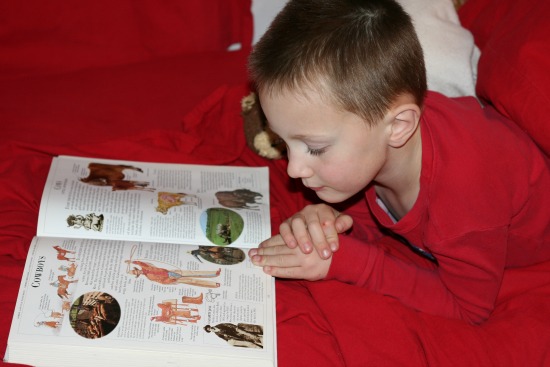
At the last library book sale (all the books you can fit in a bag for $4!), I picked up a children’s encyclopedia, and the kids found it before I managed to hide it away in our closet. It is the bedtime reading of choice for Tommy, who has constantly telling me facts like this:
“Mommy, an English horn is not English, and it’s not a horn. It’s actually made of wood.”
“Did you know that peanuts are not nuts? They’re legumes, like beans.”
“Mommy, when you were my age, you thought Pluto was a planet, but it’s not. It’s an exo-planet. Some scientists think Pluto used to orbit Jupiter.”
“Polar bears only like to live in where it’s cold, in the Arctic or the Antarctic.”
“Russia is actually part of Europe AND Asia!”
“Here is the order of the planets from the sun. Mercury, Venus, Earth, Mars, and then there is an asteroid belt before the outer planets of the Solar System…”
I didn’t teach him any of this stuff. But it’s a perfect example of the facts acquisition stage (what Dorothy Sayers calls the “Poll Parrot” stage of child development), and it reinforces my commitment to the classical model of education.
Right now, Tommy’s love of random facts picked up from encyclopedias, space program documentaries, Sunday School, and (to a much lesser extent) kindergarten is exactly what I would expect of the poll-parrot stage. In classical circles, we call this the “grammar stage,” but that term seems to give my unschooly friends visions of us doing parts of speech flashcards with the kids at age 4. (No, we haven’t started studying formal grammar with anyone yet!) It’s important to note that most of his fact acquisition comes outside of formal schoolwork (he spends less than 10% of his waking hours “doing school”), and it’s also important to note that he thoroughly enjoys it. Memorization of facts only seems onerous to us as adults because it is so much harder for us!
I don’t think my kid is gifted, and when I talk to other parents of kindergartners, this information acquisition is pretty standard. Kids Tommy’s age like picking up facts, even if they don’t really know how to use those facts (that process happens in the next stage of classical education, the logic stage). So as his teacher, I try to incorporate fact acquisition into the school that we do. We study the big world map over the dinner table and name different countries in each continent. Bible verse memory, beginning addition facts, and French vocab words are all fun and games, and Elizabeth has started begging me to let her skip her nap so that she can “do the fun stuff that you and Tommy are doing” (eg, schoolwork). I’ve given in on the school (not the naps) and let her start learning the ABC Bible verses, and she loves it! The other night, she even told me that she needs her own ‘cyclopedia for bedtime reading…
I don’t see how Sayer’s observation about the “poll parrot” stage is distinctly classical. She’s observing something about young children that people from all education philosophies have noted. Namely, that little children are sponges for information and learn most easily through rhymes, silly songs, etc. Where the education philosophers depart is how to use that observation.
The unschoolers/let’s-delay-formal-education types think that children should be given lots of wonderful resources to explore their world and should be read endless books and enjoy lots of unstructured play until age 8 or so. Interestingly, Sayers also ascribes to the delayed model. Her grammar stage does not begin UNTIL AGE 9! (Seriously, she actually lists that age in the essay.)
I would say that reading encyclopedias for fun (something I did as a child actually) fits much more into the unschooling model of child-directed learning than in the “classical model” which involves systematic study of language and history and science. How does the fact that most of Tommy’s learning takes place outside of formal school time mesh with the “classical” understanding of the Grammar stage?
Also, modern “classical education” starts the Grammar stage at age 5 or 6 (see Susan Wise Bauer, Classical Conversations, etc) and the work includes lots of formal fact acquisition, rote memorization, and a chronological approach to history.
I guess what I am saying Emily is that I don’t think what you’re doing is “classical” in the modern sense or even really in Sayer’s sense, unless you are saying that giving your children an educationally rich childhood is “classical.” If it is the latter, I share your commitment entirely.
Hm, this is what happens when I post random thoughts without planning or rereading. I didn’t mean to convey that reading an encyclopedia is a grammar stage activity per se. Rather, when I see Tommy memorizing facts easily, it makes me think, “He’s in grammar stage development now. What other facts should I start having him memorize now that can help him down the road?” That’s actually how Classical Conversations got started.
So what do you do when kids are sponges? The classical approach is to harness a kids’ enjoyment of parroting facts and memorizing lists and help them learn the building blocks early, while it’s fun, fast, and easy, so that they can use them when they go on to the stages of drawing connections and exploring topics more deeply. The goal is to provide an orderly foundation on which to cultivate a lifetime of learning.
Re: the age question, I also think you and I refer to different things when we talk about formal education. If by delaying formal education until age 7 or 9 you mean that children shouldn’t sit in a classroom for 7 hours a day until that age at the very earliest, I totally agree (and so would Susan Wise Bauer, who recommends about an hour max of schoolwork per grade, so a child is not doing a ‘full day’ of schoolwork until middle school). But what I mean by formal education is being intentional about what my kids are learning for an hour out of the day, and I’m not willing to delay that for several more years. So in part, this might be a question of semantics.
Sayers isn’t consistent with the age of grammar stage, and she admits she had no experience with young children herself (she abandoned her own illegitimate child to relatives). In “The Lost Tools of Learning,” she mentions age 9 but also says to start Latin when kids are enjoying “Eenie, Meanie, Miney, Moe.” My kids are enjoying that at ages 3 and 5, and honestly, they would probably enjoy memorizing Latin declensions right now. In another essay, she describes starting Latin at age 7 and says, “I am convinced that the age at which I began was the right one. An acquaintance of mine whose boy is just starting life at a grammar school tells me that the boys there do not begin Latin until they are eleven. I am sure that this is too late. In acquiring the Accidence, everything depends upon getting declensions and conjugations firmly fixed in the memory during the years when the mere learning of anything by rote is a delight rather than a burden.” (emphasis mine) I’m more willing to go with the underlying principle (rote learning is fun early and dull later) than fasten on to an age that seems to change depending on which of her essays you read!
So yes, I totally agree with the Well-Trained Mind philosophy that children should start learning building blocks at a young age, when it’s easy and fun. A five year old is not going to be able to enjoy reading an encyclopedia unless he has had a strong foundation in phonics. The right age to start formal education is still going to vary from child to child, of course, but I am very intentional about Tommy’s kindergarten memory work because I see it as foundational grammar stage work. Because it comes so easily right now, he gets a lot of formal fact acquisition in under an hour, which is my limit for how long I think little boys should have to sit still. =) As we get further along in school, we will absolutely be doing lots of rote memorization (especially of math and language and dates) and a chronological, orderly approach to history.
As far as giving kids an educationally rich childhood, letting them pursue rabbit trails and express their creativity in various ways, etc, that’s how we’re doing content subjects like art, music, and “social studies” so far, and that’s how my kids spend most of their day, which I don’t consider schooltime. I just don’t think the child-led approach is enough of a foundation for skill subjects like math and language that build on themselves. Like I said, at this point, I think 10% of the day is plenty of foundational formal schooling, increasing a bit each year as per Susan Wise Bauer’s recommendations.
So it’s interesting how we both look at the same kid behavior and draw very different conclusions about it, huh? =) It will be interesting to see how similar or different our homeschools might look in two or three years. Wish we were closer so we could talk about all this in person! =)
Thanks for all the clarification. It helped me realize that my big beef is that I hear all these new home educators say, “Oh Wow! Look at Classical education!! We’ve never done it like this before!! There was no good education until we rediscovered the classical approach.” That’s just not accurate the history. The way my mom and her friends home schooled was “classical” to the extent that you are describing your own home school approach (minus the study of Latin). So I feel like we’re not honoring the home educators who have gone before us.
If Sayer never educated young children, then how is she a good guide for the way we ought to educator ours? I’m kinda disgusted that she abandoned her child…
I think you and I pretty much agree on everything and will probably home school in VERY similar fashions. 🙂
Sayers was an expert on the classics and on pedagogical systems of the past. The things I’ve read by her have helped me define what I want to accomplish with my kids’ pre-college education. No, she wasn’t a veteran homeschool mom, and yes, I find her personal life to be kindof abhorrent (which is why I always find her attitude about mothers in Gaudy Night to be particularly hypocritical). I find Susan Wise Bauer much more helpful in how to get to that well-educated point, a year at a time. (She’s not for everyone, but my mind works the same way hers does, if that makes sense.) And I find SWB and Charlotte Mason and other educators who actually spent the bulk of their time with small children to be much more helpful on what is appropriate at what age.
I see what you mean about “classical ed” being the new, cool thing that homeschoolers are jumping on while ridiculing those sorry 80s and 90s homeschoolers who were so ignorant. That’s not only a bad and disrespectful attitude to have, but it’s inaccurate. My family did not homeschool classically, and we obviously all turned out okay. I’m drawn to the classical approach because it fills places where I feel my own education was deficient, but my closest homeschooling friend out here is doing pure Abeka workbooks with her younger four, and I feel that I have a lot to learn from her!