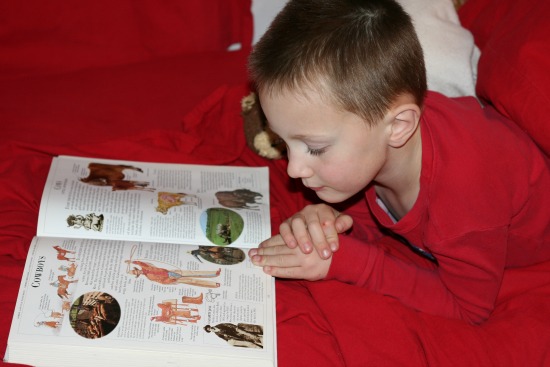
At the last library book sale (all the books you can fit in a bag for $4!), I picked up a children’s encyclopedia, and the kids found it before I managed to hide it away in our closet. It is the bedtime reading of choice for Tommy, who has constantly telling me facts like this:
“Mommy, an English horn is not English, and it’s not a horn. It’s actually made of wood.”
“Did you know that peanuts are not nuts? They’re legumes, like beans.”
“Mommy, when you were my age, you thought Pluto was a planet, but it’s not. It’s an exo-planet. Some scientists think Pluto used to orbit Jupiter.”
“Polar bears only like to live in where it’s cold, in the Arctic or the Antarctic.”
“Russia is actually part of Europe AND Asia!”
“Here is the order of the planets from the sun. Mercury, Venus, Earth, Mars, and then there is an asteroid belt before the outer planets of the Solar System…”
I didn’t teach him any of this stuff. But it’s a perfect example of the facts acquisition stage (what Dorothy Sayers calls the “Poll Parrot” stage of child development), and it reinforces my commitment to the classical model of education.
Right now, Tommy’s love of random facts picked up from encyclopedias, space program documentaries, Sunday School, and (to a much lesser extent) kindergarten is exactly what I would expect of the poll-parrot stage. In classical circles, we call this the “grammar stage,” but that term seems to give my unschooly friends visions of us doing parts of speech flashcards with the kids at age 4. (No, we haven’t started studying formal grammar with anyone yet!) It’s important to note that most of his fact acquisition comes outside of formal schoolwork (he spends less than 10% of his waking hours “doing school”), and it’s also important to note that he thoroughly enjoys it. Memorization of facts only seems onerous to us as adults because it is so much harder for us!
I don’t think my kid is gifted, and when I talk to other parents of kindergartners, this information acquisition is pretty standard. Kids Tommy’s age like picking up facts, even if they don’t really know how to use those facts (that process happens in the next stage of classical education, the logic stage). So as his teacher, I try to incorporate fact acquisition into the school that we do. We study the big world map over the dinner table and name different countries in each continent. Bible verse memory, beginning addition facts, and French vocab words are all fun and games, and Elizabeth has started begging me to let her skip her nap so that she can “do the fun stuff that you and Tommy are doing” (eg, schoolwork). I’ve given in on the school (not the naps) and let her start learning the ABC Bible verses, and she loves it! The other night, she even told me that she needs her own ‘cyclopedia for bedtime reading…