Feed on
Posts
Comments

Last week I started off our thoughts on children’s literature by discussing the moral values we require from a children’s book.  This week I’ll touch on our controversial contention that literary excellence matters just as much as moral content.

 1. High-quality writing and artwork reflect the excellence of the Creator.

We want our kids to experience art that is a reflection of God’s character.  The Creator of the universe is the ultimate artist; the beauty and order of Creation proclaims His glory. 

Some might think that artistic excellence doesn’t matter, that art is of secondary importance compared to the spiritual realm.  This is a form of asceticism, and Paul has harsh words on this topic in 1 Timothy:

  4:1 Now the Spirit expressly says that in later times some will depart from the faith by devoting themselves to deceitful spirits and teachings of demons, through the insincerity of liars whose consciences are seared, who forbid marriage and require abstinence from foods that God created to be received with thanksgiving by those who believe and know the truth. For everything created by God is good, and nothing is to be rejected if it is received with thanksgiving, for it is made holy by the word of God and prayer.

I’m indebted to Jerram Barrs for his article “Christianity and the Arts,” where he discusses this issue at length.  He says,

Repeatedly in the history of the Church, Christians have been tempted to devalue the richness of creation and therefore to devalue also the arts, as if it would be somehow more “spiritual” to live a life devoid of beauty, of good things, of music, of literature, of painting, of color, etc…In this view, the arts are thought of as an optional, rather extravagant, and unnecessary extra in life.  But this belief is nonsense, and is, according to Paul, a heresy of the most serious kind, for in the end it is a denial of the goodness of creation.

The literature our children read should reflect the beauty our Creator lavished on every aspect of creation.  If we allow our children to read books with “safe” moral content that are poorly written or sloppily illustrated because aesthetics don’t matter, we’re communicating a false view of God’s role as a creator.  God created a beautiful world and said that it was Good!

I know a couple people who really disagree with us here!  Responses? More tomorrow…

(to part four)
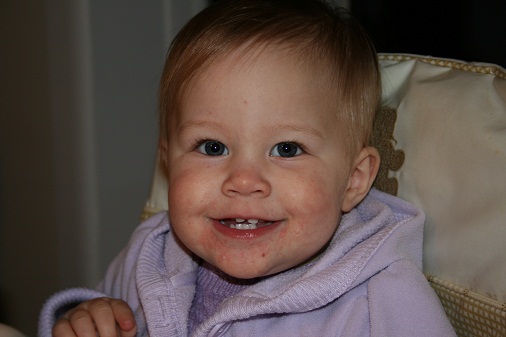
Elizabeth at 18 months

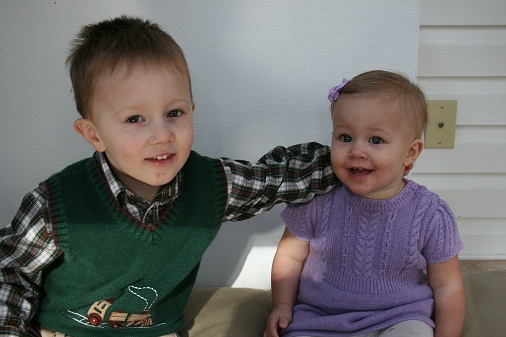
It’s pretty crazy to think that Elizabeth is 18 months old today!  She’s changed a lot this past month…completely dropped her morning nap (she was in the process of dropping it last month), eating everything with a fork or spoon, growing out of her 12-18 month clothes (she must be “normal” to clothes makers), and most charmingly, developing a real love of books.  You can’t be around her for more than a minute or two before she’s off to the bookshelf for one of her favorites, then returns to plop down on your lap expectantly.  I don’t think she’s quite had the big language break-through yet, but she is saying lots of words and (unlike Tommy at this stage) sentences.  Lately I’ve been hearing a lot of “book,” “ball,” “cheese” (=the food), “I cheese” (=you need to come take a picture of me right now because I’m smiling really cutely), “I hummy” (=I’m hungry, I’m thirsty, I want what you’re having), and “moMMY” (usually loudly).

For those who were wondering, she has not once tried to get out of her crib since the fiasco on her 17 month birthday.  She still doesn’t like going down to bed, but she’s staying in really well.  She’s become more clingy in social situations, sticking to me like glue when we go into church, Bible study, the playground, or the library, but once she relaxes, she’s enjoying social interactions, especially with her little group of church friends whom she sees 3 or 4 times a week.  When she’s really out of whack (from daylight savings this past week), she’ll happily sit on my lap quietly through an entire church service or Bible study meeting.  (Tommy would NEVER sit still on my lap for an hour at this age!)  She is starting to throw huge temper tantrums, usually when she’s frustrated about how something is going.  Yesterday she wanted to stay in the library instead of coming home for lunch, so she launched into a 25 minute screaming fit and then collapsed without lunch for a 3 hour nap.

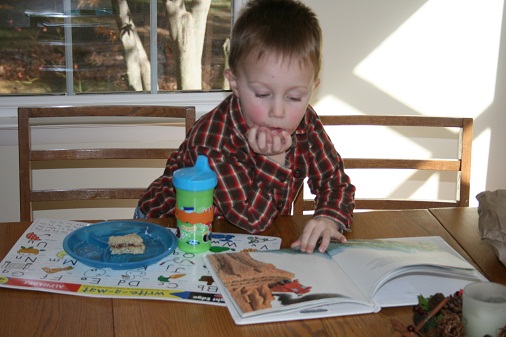
Her favorite toys are whatever Tommy is playing with.  If he’s doing cars, she wants to play cars.  If he goes to her room and sets up a tea party, she’ll sit down and have one.  If he’s cooking, she has to get her apron on, too, and she needs her own pan and spoon.  If he’s reading books by the bookshelf, she’ll plant herself there with The Polite Elephant and Animal Orchestra.  If he’s coloring, she wants to color (though she has a tendency to eat the crayons).  If he’s building a fort on the couch, she wants to get in there, too.  When he dances to “Jingle Bells,” she immediately joins in.  It’s really cute to see how much she adores him.  When we come in and get her up from a nap, the sight of her Bubba is enough to cause chortles of glee!  Fortunately, Tommy still feels the same way about her, most of the time.

Maybe it’s because I’m so much in new baby mode with the pregnancy, but I’ve really stopped thinking of her as a baby and consider her a full-fledged little girl.  She’s so full of personality that we can’t remember what life was like before.  I’m blessed daily by her cheerful disposition and cute smile!

Home from the Library

The Elusive Smile

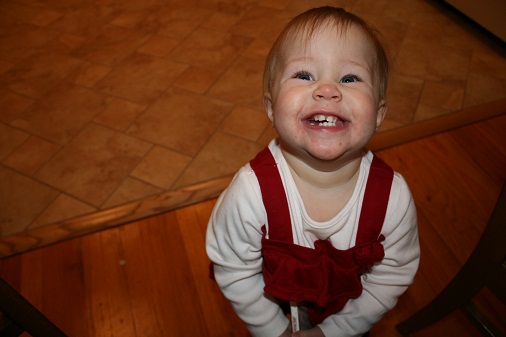
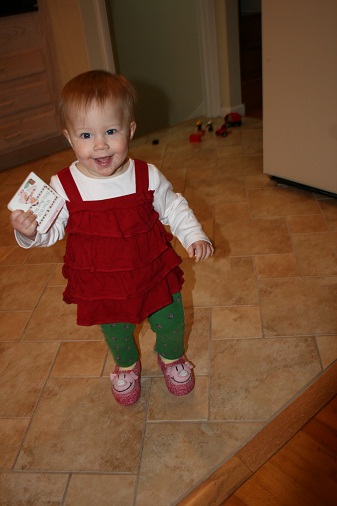
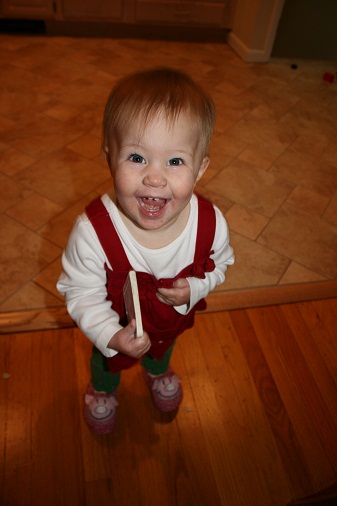
Yesterday I tried to have a friend come over to take Elizabeth’s professional 18 month picture.  Tried was the operative word.  In my dry run on Sunday (pictured above), she was all smiles.  This time, ten minutes before Lauren got here, Tommy spilled water all over her dress.  Between the dryer and a hair dryer, we managed to get started almost on time.  Then the Little One refused to smile.  We tried getting Tommy out with us to laugh at her, but he only ran into the pictures and distracted her (then screamed and threw a tantrum when I sent him back inside).  We tried playing “Jingle Bells” on my ipod and dancing like we’ve been doing for the past couple days.  We tried playing with the soccer ball, exploring the woods behind our house, pulling out the rocking chair, throwing leaves, and all the funny noises we could think of.  You’d think two moms of 1 1/2 year olds could get one 1 1/2 year old to smile.  But my smiley girl’s smile remained elusive.  After 45 minutes, we admitted defeat. 

As soon as Lauren drove away, Elizabeth was laughing again and her old, smiley self for the rest of the evening.  Grrrrrrr.

On a positive note, Lauren was able to catch a few good shots among the probable hundreds of frowns–check them out at her website.

Yesterday I started off by talking about what we define as morally excellent literature for our kids right now (3 1/2 and 1 1/2).

Um, isn’t this a bit limiting?  A lot of the great literature of the Western Canon doesn’t match up with Biblical Truth.  We’ll be reading a lot if it as a family—just not yet.  We’re going to address things as the kids reach the age where they encounter those issues in real life.  Tommy’s blessed to have a bunch of friends with loving parents right now.  We’re not going to do a lot of reading this year on abusive husbands, adultery, teen pregnancy, or parents who abandon their children.  As his life experience encounters similar situations and his maturity grows to be able to process such things, we’ll talk about them and read about them.  (One of my biggest problems with “young adult fiction,” which I sometimes don’t think should exist, is that it hits kids with adult issues they’re not ready for yet.)  Thankfully, there’s a plethora of great children’s literature with appropriate content that we’ll enjoy in the early years.

As our children grow in discernment, however, we’ll be able to expose them to more divergent ideas so that we can discuss them together and train them to assess the worldview.  Derek and I love A Series of Unfortunate Events. It’s pretty dark, though, and there are some pretty big philosophical questions that the Baudelaire orphans have to face as they struggle for survival.  We’re not going to be reading them with the kids until they have the maturity to discuss them—probably not for at least a decade.  But we will read them, because they’re great literature, and they’re great conversation starters.  I personally love detective fiction, and I can’t wait to read great authors like Dorothy Sayers, G.K. Chesterton, and Josephine Tey aloud with the kids.  Sayers makes the point that murder mysteries are a moral anomaly in 20th century literature because the bad guy always gets caught (!), but obviously there’s content—infidelity, lies, intrigue, even some colorful English profanity—that won’t be appropriate until the kids are teenagers.

Our goal is not to shelter our children, but to train them to evaluate everything they read against the standard of Truth.  As Nancy Pearcey points out in her excellent book, Total Truth,

The dominant methodology in many Christian schools and churches has been to protect children from nonbiblical ideologies, and in part that is educationally sound.  It makes sense to protect children until they are developmentally ready to handle complex ideas.  But in many cases children are never exposed to competing ideas within their families, churches, or Christian schools, and as a result they go out into the world unprepared for the intellectual battles they are about to encounter, especially on secular college campuses.

When these young people start their classes and are confronted by new, plausible-sounding ideas, they may begin to wonder whether the adults in their lives were covering something up.  They may suspect that their parents and teachers did not criticize competing ideas because there are no good criticisms—that they did not demonstrate how to defend Christianity because it is indefensible.” (Total Truth, p. 126)

I’ve seen what Pearcey describes first-hand, and I’m so grateful for the worldview training my parents gave me so that I didn’t falter when faced with conflicting ideologies, especially those in the books I read.  I am convinced that Christianity is coherent and defensible, especially compared to the other belief systems I’ve encountered!  So to bring things back to the literature our children read, we have two major goals—to ground them from a young age in literature that reflects truth, and then to introduce books with divergent worldviews at an intellectually appropriate age.

Thoughts?  Next week I’ll tackle the touchy question of setting a standard of literary excellence…

(to part three)

If you didn’t know, Derek and I are passionate about children’s literature.  So several months ago, I had a long conversation with some dear friends about what kinds of books we’re having our kids read.  Derek and I want our kids only to read books that are both morally and aesthetically excellent.  Some of our friends don’t find the latter half of that important.  I would rather have my kids read well-written literature with loveably flawed protagonists who learn from their mistakes than poorly written literature with morally uncompromised characters.  Some parents feel the opposite.  That sets up an interesting question of what constitutes moral literature and why the quality of the writing (and illustrating) matters to us as much as the content.  The ensuing conversation and debate over our ideas sent me on a journey of researching homeschooling book lists, rereading my childhood favorites, studying Christian commentaries on the arts, and trying to organize my thoughts into a coherent format.  This post is the first in a series on my (and Derek’s) standards for children’s literature.  I’ll try to post a couple sections a week for the next several weeks.  Our literary philosophy is still a work in progress, so I welcome questions, comments, and criticisms from my friends!

First, I think it’s important to define what Derek and I consider to be morally excellent literature.  Today we’ll look at our requirements for the books that our kids are reading now.

For young children, literature should reflect Truth.

We want our children to read books that reflect the reality of God’s creation.  Mankind is fallen, there are consequences for sin, and we are saved by grace through faith in Jesus Christ.  What does this look like in practical terms?  We don’t think that every book the kids read should have the gospel message spelled out explicitly.  Jesus isn’t mentioned by name in most of our current favorites.  But whatever level of plot there is (whether it’s about a little bunny enjoying a beautiful spring day, a little girl whose Mommy won’t let her get lost on Blueberry Hill, a frog and a toad who enjoy a sweet friendship, or four orphan children living in a boxcar who discover that their grandfather loves them), it shouldn’t undermine the truth of God’s world that we work so hard to instill in our kids.

We don’t want the kids’ literature to be amoral.  If a character sins, there should be consequences for his actions.  If a bunny disobeys his mommy, trouble should probably result.  If a little badger has a bad attitude about a friend, it should cause her discomfort until she makes peace.  If a little girl hits her sister, she shouldn’t get away with it.  When I see a book in which disobedience or bad attitude is not addressed, I do not read it to the kids.  Notice that we don’t mind if the characters are imperfect as long as sin is shown to cause trouble.

Our friends ask, isn’t there a danger in making those naughty characters too loveable?  Well, that’s kindof our point.  Tommy relates to Peter Rabbit, Frances the badger, and Laura Ingalls because he sins in the same way they do on a daily basis.  Their struggles are his struggles, and like him, they discover that they can’t get away with naughtiness.  In the Bible, we have one perfect example and a whole lot of flawed examples of how not to do things.  God didn’t hold back from giving us stories with sinful participants.  On the other hand, I have a hard time with books where the protagonist is unrealistically good.  Not only can we not relate, but I don’t want my kids believing that children can be perfect if they just try hard enough.  Virtue doesn’t exist in a vacuum, and books written by well-meaning Christians to extol certain “character qualities” are often simplistic and flawed.  I don’t think they exhibit the reality of man’s depravity as easily understood by my three year old.  I’ll do a whole separate post later on why Elsie Dinsmore and similar Victorian-era sentimental literature with perfect children concerns me.

Thoughts?  Responses?  Tomorrow I’ll talk a bit about where this leads as the kids get older…

(to part two)

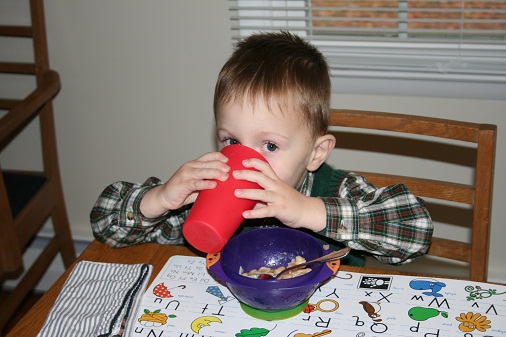
A Big Boy Cup

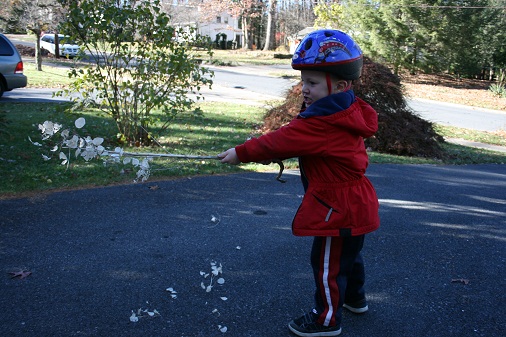
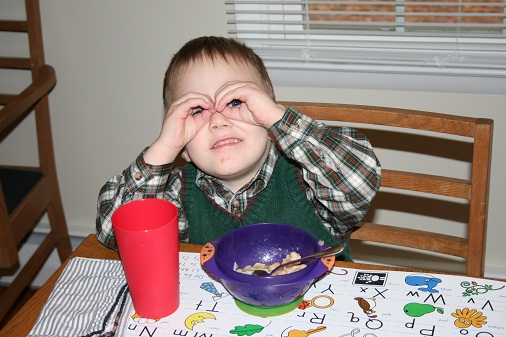
I have been so lazy about moving Tommy out of a sippy cup, but Derek finally got on me enough to go out and buy a big boy cup this weekend!  Tommy loves being so grown up!

Fresh Air

"Book! Book! Book!"

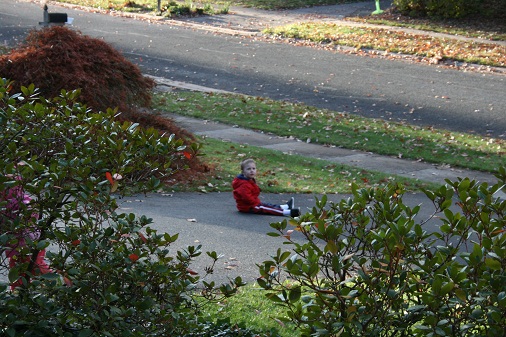
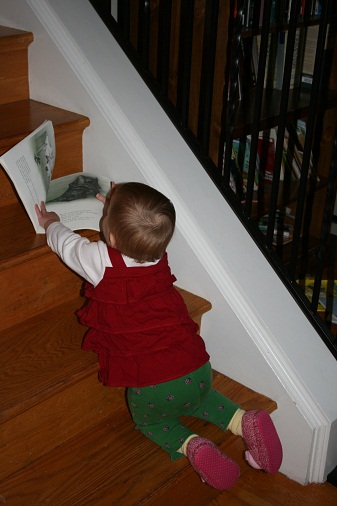
Elizabeth’s favorite words these days are “MOMMY!” (as loud as possible) and “Book!” (always an exclamation).  I’ll be doing preschool with Tommy and hear her calling, “MOMMY–Book!  Book!  Book!”  Around the corner she comes, clutching a book that I need to read that very second, thank you very much.  How can I resist such a smiley request?

Then it’s off to get another one…

And maybe read it to herself…

« Newer Posts - Older Posts »