The Little House series is almost universally recommended for young girls, but that shouldn’t stop us from making sure that it measures up to the standards we have for our children. Continue Reading »
I have so many little matters to tell you of, that I cannot wait any longer before I begin to put them down.
Nov 29th, 2010 by ECM
The Little House series is almost universally recommended for young girls, but that shouldn’t stop us from making sure that it measures up to the standards we have for our children. Continue Reading »
Nov 24th, 2010 by ECM
So I have NOT been good about keeping to the food budget this fall. With being so sick for so long, I had to resort to quicker (and more expensive) meal options, and more eating or ordering out than in our previous six years of marriage combined. But when turkeys went on sale for $0.29/lb last week, I decided it was time to embrace my thrifty side again.=) I picked up a 10 lb, 15 lb, and 20 lb turkey, and my freezer is nice and full. Last week we had friends over for dinner to use the 10 pounder, and I was able to feed nine people roast turkey, mashed potatoes and gravy, and green beans for under $8 total. (Jenny brought the dessert.) Then I spent half an hour the next afternoon picking apart the carcass and came up with five cups of chopped turkey which became turkey-rice burritos and turkey tortilla soup later in the week. (Both recipes made plenty for leftovers.) Then, totally inspired by Kristen (who told me even I could do this), I simmered the bones and scraps overnight in my crockpot to make homemade turkey broth. I’ll go Pioneer Woman and show the step-by-step:
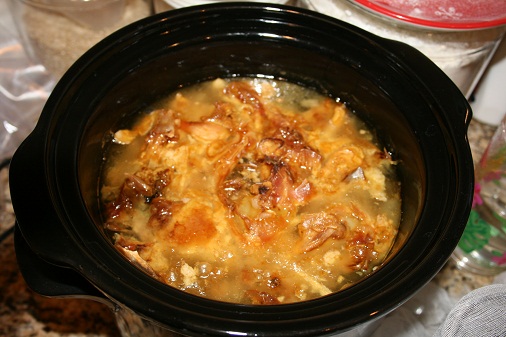
First I pulled apart the carcass and dumped it all into the crockpot, covered it with water, and turned the crockpot on overnight. I hate the smell of simmering carcasses (I beg my dad to wait ’til we’re gone when he does them at home), but since it was on the back porch overnight, I didn’t have to smell it! Here’s how it looked after about 11 hours:
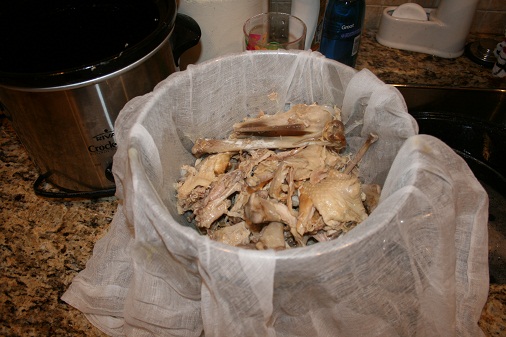
Then I lined my colander with cheesecloth and set it in another bowl and dumped everything into it. The cheesecloth caught all the bones and the ooky stuff. How does Pioneer Woman do those action shots of pouring? Imagine me pouring.
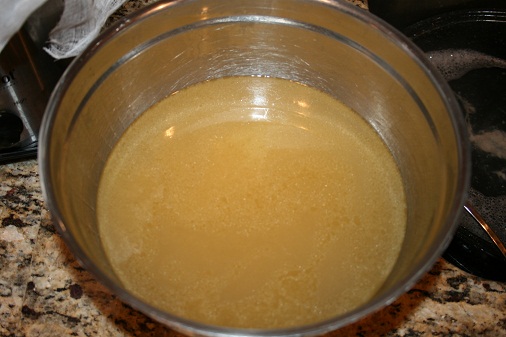
Then I lifted out the colander and had nice, fragrant broth with no ooky stuff in it. I skimmed off part of the fat that immediately congealed on top, but I was too impatient to do a thorough job.
I think I got about 8 cups of broth out of it–since we’re out of town this week, I just packed them up and stuck them in the freezer. I’ll pull them out when I have a recipe that calls for chicken broth! No added salt or anything, just pure broth. =)
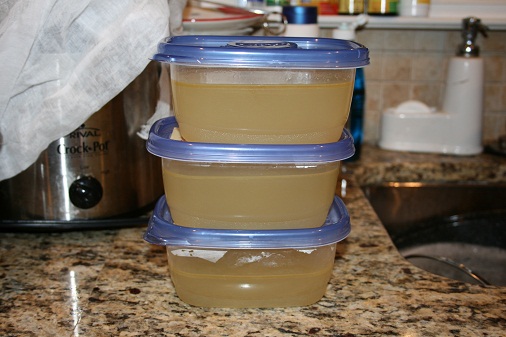
So that’s a meal for 9, enough leftover turkey to create two more meals plus leftovers from each, and 8 cups of broth.
Have I mentioned that this is all with a $3 turkey???
Since we’re not spending Thanksgiving or Christmas at home, I’ll roast up the remaining turkeys in our freezer whenever I feel like turkey and company this winter. I’ve been intimidated by the whole “cooking a turkey” thing and especially the making broth part, but it was actually easier than I thought. Why have I not been doing this all along? Now I’m trying to plan ahead for other dishes we like with cooked chicken/turkey. I’m thinking of turkey pot pie, turkey enchiladas, white chili, and turkey noodle soup. What other precooked chicken/turkey dishes should I be making this winter? Help me keep this frugal streak going! =)
Nov 23rd, 2010 by ECM
We’re caught up on youtube! Here are the kids dancing last week:
Nov 22nd, 2010 by ECM
(Parts One, Two, Three, Four, Five)
Why Does This All Matter?
Okay, at this point you may be thinking we’re compulsive about a relatively unimportant area of our children’s lives. After all, it’s just books!
For our family, books are the single most influential media form we encounter. We watch very little TV, we rarely see movies, and we don’t listen to the radio. The kids are not allowed online, though occasionally they’ll watch youtube videos of their friends. Our kids spend more time daily with books than with any particular toy.
Because of this focus on books, we’ve decided that we have a responsibility to ensure that the books we read are excellent. This is perhaps easier for us because we’ve both studied literature in college, but we’ve also done a lot of philosophical reading (I’m very influenced by C.S. Lewis and his disciples) on the topic. (I’ve also tried to note valuable resources we’ve found in our search for books of excellence, and I’ve appreciated the great suggestions from some of you.) We will try to address other areas as they come up: Derek is currently doing an “independent study” of children’s cinema to come up with standards and acceptable choices for our family there; my dad is a professional classical musician, so we look to him for guidance in music; neither of us is super-knowledgeable on art, but we’ll seek guidance in that as our children develop an interest there. But right now, it is pragmatic to concentrate our energies on the books we read.
Partially this emphasis on books is a choice we make because Derek and I both love to read, but it’s also important to us because of the role that stories have in shaping the moral imagination of our children. There’s a wonderful Alan Jacobs interview on Mars Hill Audio Journal that discusses this point in the context of (yes!) C.S. Lewis. Jacobs raises the Augustinian notion that we’re defined by what we love. I want my children to love “whatever is true, whatever is honorable, whatever is just, whatever is pure, whatever is lovely, whatever is commendable, if there is any excellence, if there is anything worthy of praise.” What kind of literature trains the mind towards what Jacobs and Lewis call “the baptized imagination” so that the individual loves these Philippians 4:8 qualities? Hopefully in this series Derek and I have argued coherently alongside Lewis that the best kind of literature for this task is that which is of moral and aesthetic excellence.
How realistic is this goal? It’s helpful to compare it to food. While the ideal is for me to serve my children home-cooked, from-scratch meals every day, sometimes that isn’t going to happen (especially when I’m in the midst of a difficult pregnancy or sleep-deprived with a new baby!). While this series is addressed mostly to fellow parents and parents-to-be, all of us have other jobs and responsibilities outside of parenthood that will prevent us from controlling the quality of every bite that goes in our kids’ mouths or every book that they read. And this is okay. It is not sinful to eat box brownies or read Janette Oke. Furthermore, we’ve all read some literary trash in our lives and survived—I inhaled the Mandie books in the church library in 5th and 6th grade; Derek entered marriage with a complete hardback collection of the Left Behind series. But there are hundreds of morally and aesthetically excellent children’s books out there, and we aspire to focus the bulk of our reading there.
This is our family’s personal position. I’ve made the decision to take a confident tone in expounding on it because I wanted to provoke discussion and be persuasive—it’s what I tell my high school students to do when they’re writing essays. I want to repeat that I do not stand in condemnation of friends who might disagree with us or friends who have simply never considered the topic. (I do, however, feel unhappy that some Christian organizations aggressively market mediocrity to parents who then assume their only choice is between morally-good-aesthetically-bad or morally-bad-aesthetically-good literature. That’s a false dichotomy. The excellent Sonlight, Bethlehem Books, and Veritas catalogues are full of morally and aesthetically excellent choices for our children, and we would do well to follow their lead. We do not have to put up with mediocrity in our efforts to raise virtuous children.)
In Conclusion…
So ideally, we don’t want to compromise on the philosophical or literary merit of the books we read our kids. When we look at a book, we ask two basic questions: Does this accurately represent God’s creation? and Is this a work of literary and artistic excellence?
In the coming weeks, I’m going to try to hit on some of the series mentioned in the discussion with my friends or that get mentioned in the comments, and I’d really love to hear feedback from my fellow bookworms, other moms, and homeschoolers! Are there any books you’d like us to discuss together? We can think of this as our online reading club. I’m looking forward to discussing old favorites and discovering new ones.
(Next week: The Little House series)
Nov 19th, 2010 by ECM
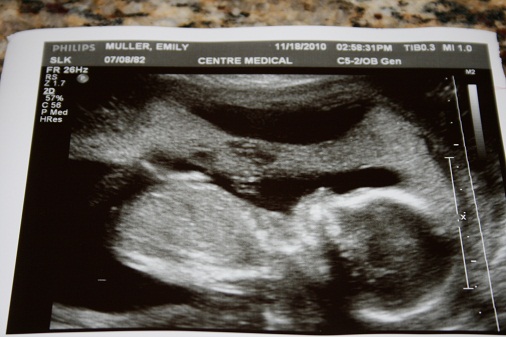
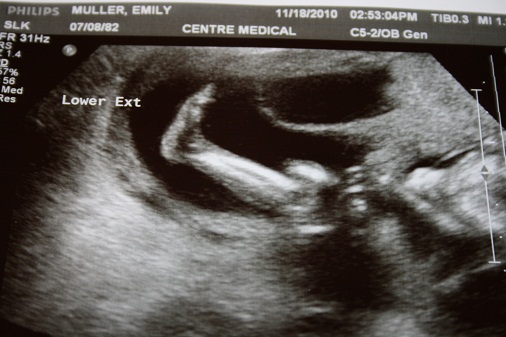
So things have been happening quickly around here. After the vaccine fiasco of Wednesday, I got on the phone Thursday and found the kids a new pediatric group and myself a new OB-GYN group. Since I’m 19 weeks pregnant and due for an ultrasound (but will be out of town for the next 8 days), they said, “Can you come in this afternoon for an ultrasound?” We rushed around and got ourselves together to the new clinic by 2:30, where we all got a much better picture of Baby #3 than we’ve had at previous ultrasounds! No, we didn’t find out the sex, and we don’t have any “educated guesses” like last time (when we mistook Elizabeth’s umbilical cord for boy parts…). The baby was healthy, weighs 9 ounces, and measures on track for an April 13 duedate. At one point, Baby waved at us, and Tommy waved back! Elizabeth just pointed to the screen and yelled, “Baby! Baby!” It was a fun way to change practices!
Head in profile–I love the little nose
Kicking
Nov 18th, 2010 by ECM
Elizabeth had a really eventful trip to the doctor yesterday, and I want to thank my lovely readers who have commented on my literature posts for helping keep my mind off medical malpractice last night! I really needed the distraction…
So yesterday Elizabeth had her 18-month check-up. The doctor told us that due to her egg allergy, he didn’t want her to get the seasonal flu vaccine because it is made with eggs and could potentially be dangerous for her. He referred me to a local allergist and told me they’d do testing there to determine if the vaccine was safe enough to administer in their controlled environment. I agreed. So she was just going to get her scheduled Hep A shot. Tommy was to get his flu shot at the same time. The nurse came in, gave Elizabeth a shot, looked troubled, left us alone for 5 minutes, then came back in to tell me that he had just given Elizabeth Tommy’s flu shot by mistake. The flu shot that the doctor had just told us not to give her. I won’t go into detail into how the entire situation was mishandled from there, but we are selecting a new pediatric practice today. And I am still shaking with anger as I type.
Fortunately, Elizabeth seems not to have had adverse reactions to the shot. I am SO thankful for that. Here’s how she’s measuring up compared to her brother:
Elizabeth at 18 months:
Height: 32.5 ” (75%)
Weight: 25 lb 9 oz (68%)
Tommy at 18 months:
Height: 32.75 ” (60%)
Weight: 29 lb 5 oz (80%)
Wow, I didn’t realize that they were essentially the same height, but Tommy was four pounds heavier! What a porker! =)
Nov 18th, 2010 by ECM
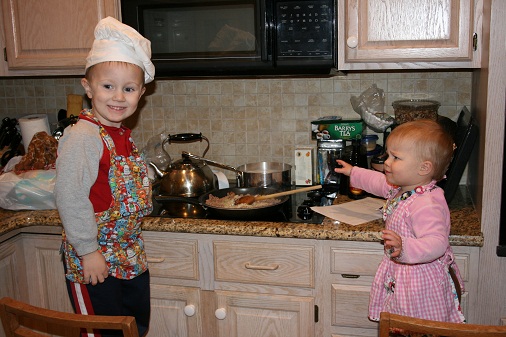
These two just LOVE to help Mommy cook…
Nov 17th, 2010 by ECM
I wanted to wait on this until more people had had a chance to read it (you can do it online here), but I think we’ve discussed her so much in general in the comments that I need to address my concerns with her now. Continue Reading »
Nov 17th, 2010 by ECM
One more day to discuss the importance of literary standards of excellence…
3. Good Literature Develops Our Literary Palate
If the aesthetic merit of a book matters, how do we teach young children to discern it? We learn the difference between great and badly-written literature by studying the rules of grammar, composition, and rhetoric. We also learn this practically by reading good examples. It’s hard for a five year old to explain the difference between the clean prose of Laura Ingalls Wilder and the sloppy writing of the latest mediocre kid-lit writer, and that’s why it’s so important to fill his mind with good writing so that he’s developed a taste for excellence. Children who hear proper English spoken all the time naturally pick it up and may cringe at poor grammar even before they’ve studied it in school. (I naturally say “This is she” on the phone because my mom modeled that for me years before I learned about the difference between “she” and “her.”) The child exposed only to well-written literature can learn in time to distinguish for himself when he picks up junk, even if he can’t yet elucidate the exact literary techniques in question. (This applies to illustrations, too. We try to expose our kids to great illustrators—Tasha Tudor, Beatrix Potter, Robert McCloskey, Ezra Jack Keats, and Gyo Fujikawa are some of our current favorites—because why not spend time looking at real art instead of computer-generated mediocrity?) You wouldn’t train your child’s palate by serving them only chicken McNuggets and spaghettios; why are so many parents content to give their kids literary junk food and yet expect that they’ll be able to appreciate Austen or Shakespeare?
Parents can train their child’s literary palate. Growing up, my mom spent just as much or more time discussing the writing style of my books as the moral questions. I was an early and voracious reader, and I don’t think she could possibly have had the time to keep up with everything I read, but we read enough together that I had a very good sense of what she’d think of a book’s style even if she hadn’t read it. You don’t have to have been an English literature major like me—my mom was trained in microbiology!—to point out to your child a beautiful turn of phrase or a melodramatic and unsatisfying plot line. C.S. Lewis said that “a children’s story which is enjoyed only by children is a bad children’s story. The good ones last.” (“On Three Ways of Writing for Children”) If you as an adult find a children’s book unsatisfying, it’s a good bet that your child doesn’t need to read it. If you still find yourself captivated by the illustrations or storytelling of a children’s book, it’s usually a sign that the book was created with care and attention to the rules of good writing.
At the very least, parents who don’t have the time to keep up on their kids’ reading can educate themselves on the authors (generally, books found both on the Newberry or Caldecott Honor lists and in a Christian compendium such as Books Children Love or The Book Tree will be works of both moral and literary excellence). It’s a lot of work, but parenting is a full-time job!
And of course we should pick the cream of the crop when we’re doing our family read-aloud time. My whole family grew as readers by listening to my dad read aloud David Copperfield, The Lord of the Rings, and A Christmas Carol. I don’t know anyone who objects to the values or the beautiful writing of The Chronicles of Narnia, so that’s a great place to start!
Now I know this is pretty controversial subject matter with some of my friends, so we’ll pause here for comments and discuss why this is all important to us next week!
(to part six)
Nov 16th, 2010 by ECM
Continuing in my defense of the importance of literary excellence…
2. We aren’t relativists when it comes to art.
We believe in artistic standards of excellence. We who hold to absolute standards of truth shouldn’t suddenly become relativists when it comes to art. The beauty of the humanities is that an individual’s enjoyment of a work of art is partially subjective; Derek loves 20th century Southern authors, while I prefer 19th century British novelists. However, within literature, as with other art forms, there are established rules for good writing.
In An Experiment in Criticism, C.S. Lewis mentions distinctions of good children’s literature: “descriptions that really describe, dialogue that can produce some illusion, characters one can distinctly imagine.” Here’s how it works for us right now. Tommy’s really into trains, and the clever Thomas the Tank Engine marketers have produced a lot of pulp book tie-ins that appeal to little boys like Tommy. However, these books are not works of art or even written by real authors. Instead of giving Tommy Thomas books (which are morally acceptable), we have provided him with train-themed books with quality illustrations, dialogue, and characters—The Little Engine that Could, Choo-Choo, The Caboose Who Got Loose, and The Little Red Caboose. This decision is not based in my dislike of Thomas mania (for the record, Tommy is NOT named after the train), but in the fact that our books are objectively better literature.
I love how Lewis explains literary standards.:
The rules for writing a good passion play or a good devotional lyric are simply the rules for writing tragedy or lyric in general: success in sacred literature depends on the same qualities of structure, suspense, variety, diction, and the like which secure success in secular literature…Christian Literature can exist only in the same sense in which Christian cookery might exist. It would be possible, and it might be edifying, to write a Christian cookery book. Such a book would exclude dishes whose preparation involves unnecessary human labour or animal suffering, and dishes excessively luxurious. That is to say, its choice of dishes would be Christian. But there could be nothing specifically Christian about the actual cooking of the dishes included. Boiling an egg is the same process whether you are a Christian or a Pagan. In the same way, literature written by Christians for Christians would have to avoid mendacity, cruelty, blasphemy, pornography, and the like, and it would aim at edification in so far as edification was proper to the kind of work in hand. But whatever it chose to do would have to be done by the means common to all literature; it could succeed or fail only by the same excellences and the same faults as all literature; and its literary success or failure would never be the same thing as its obedience or disobedience to Christian principles.” (“Christianity and Literature”)
There are absolute standards of excellence in literature, and that it’s important to acknowledge them. Furthermore, as Lewis points out, the skills necessary to create great Christian art are the same skills necessary to create great art in general. Today’s Evangelicals are often so stuck in our little Christian ghetto that we refuse to acknowledge that by letting go of high standards of artistic expression, we’ve come to judge our art, literature, and music only by what Lewis calls ‘obedience…to Christian principles’ and and not by centuries-old rules of good art. I see this especially in the homeschool community. Martha Finley wrote a series of books about a perfect heroine intended to instill Christian principles in young girls, so they must be good literature. L.M. Montgomery wrote a series of books intended to delight young girls with the hilarious exploits of a realistic orphan girl, but those books are suspect because they are not explicitly Christian and because their heroine (gasp!) is imperfect. Both series are by Christian authors, but because the Elsie books are chock-full of scripture verses, mothers give them to their daughters despite their abysmal writing style while hesitating about the worldliness of Anne of Green Gables. I’ll be blogging on the literary and spiritual value of both series later on, as the contemporary treatment of these two series is a particular pet peeve of mine!
If we paid more attention to the literary merit of books, we’d be better equipped to dialogue with others about children’s literature. Remember the Harry Potter controversy when those books were coming out? Having read them, I can say that The Chronicles of Narnia are better—not because Narnia’s fantasy has elements of Christian allegory (which makes it “safe” to Potter critics), but because Lewis is a more skilled, thoughtful, beautiful writer than Rowling.
Can you tell I love Lewis? I’ll continue on this topic tomorrow…
(to part five)