The Kids of Carcasonne (BGG; released in 2009) is a child’s edition of Carcassonne (which I’ve discussed before). There are two real negatives before I begin this review. First, it’s probably my favorite game for the kids, so the rest of the reviews have nowhere to go but down–but really, there are other great games too! Second, it’s out of print… but Rio Grande games promises that it will be reprinted soon.
To the game. This game is perhaps one of the sharpest contrasts to a typical board game. In a game like Candy Land, the beginning of the game looks pretty much like the end of the game. There’s a board with tokens on it; the end of the game looks pretty much like the beginning, except that the tokens are in a different place.
The Kids of Carcassonne, however, is a tile-laying game. The world is barren. It’s entirely up to the children to create the gaming surface. Consider what the beginning of the game looks like:
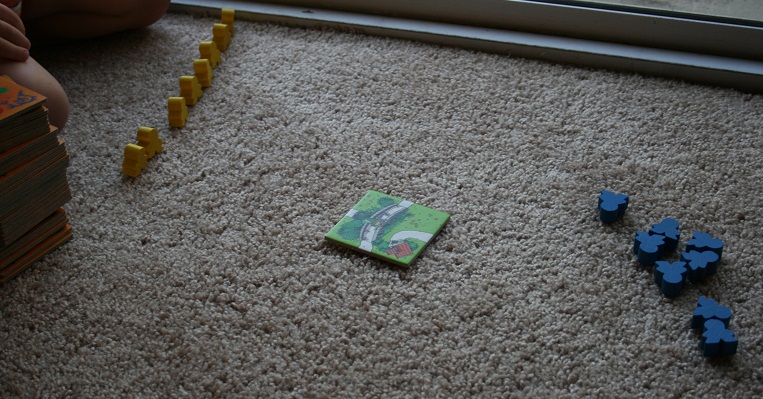
And compare that to the end of the game:
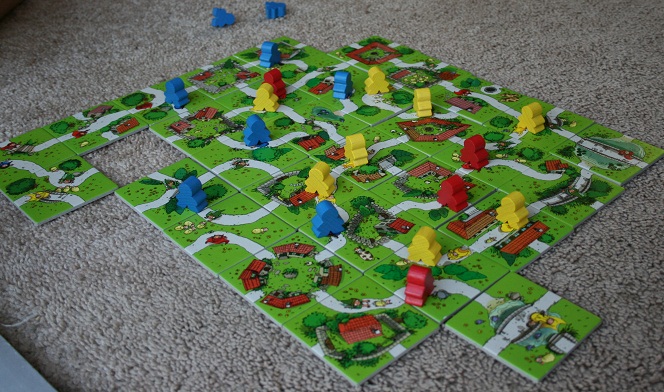
The kids have created their own world of houses and villages and bridges and fences and sheep pens. There are times after the game is over where Tommy asks to use the leftover tiles to finish up the city, or where the kids imagine that the meeples are chasing the sheep along the roads they’ve constructed. The act of participating in the creation of the game board really invests them in that world and, in my view, stimulates their creativity.
The game operates much like Carcassonne–you draw a tile and place it. When you complete a road with your character on it, you place your meeple. The first to place all eight meeples wins the game.
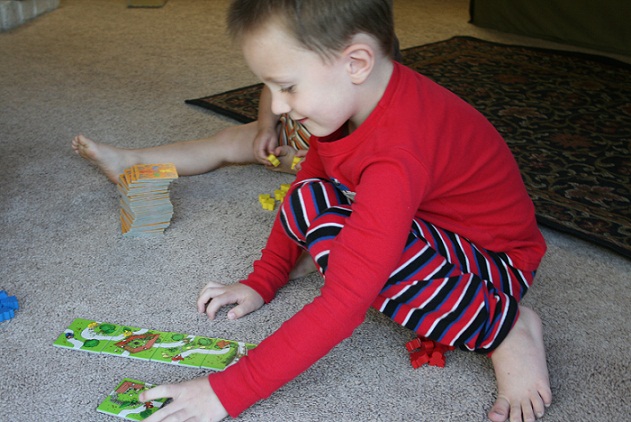
It’s obviously a much simpler version of Carcassonne, but it teaches them the same kinds of mechanics (tile placement, meeple placement upon completion of a geographic achievement, etc.). It is literally impossible to play a tile incorrectly–all sides of all tiles have road segments. The trick is where to place the tiles and how to close off a road. The randomness is whether you draw the tile you want; the strategy arises in deciding how to use that tile.
Tommy started playing this when he was almost three (starting probably around two years, eight months), and Lizzie has regularly played for some time, too. Three-year-olds can’t strategize much–they don’t exactly know why they’re placing the tile, and they often don’t know when they’ve closed off a road. But with a little direction from parents, they can place the tiles and the meeples. And they can have a lot of fun!
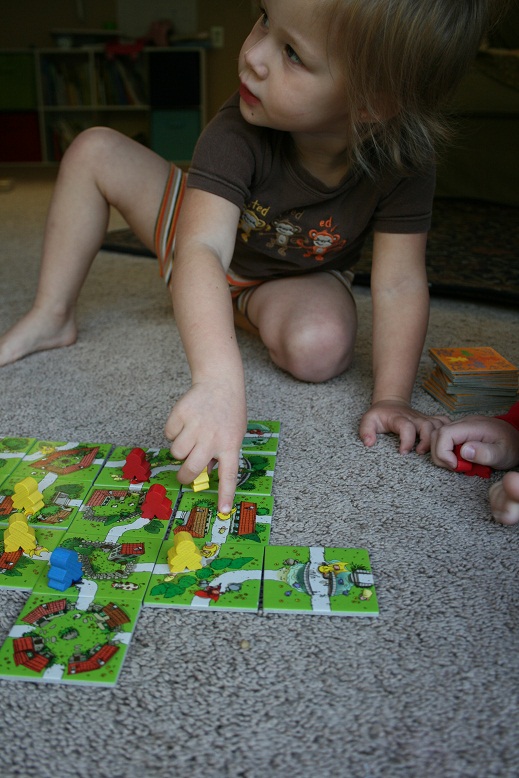
Tommy really picked up the strategy shortly after he turned five. And now he can legitimately play the game and compete head-to-head against me without any help–he wins regularly! He knows how to place his tiles, and he even knows how to foil me a little. So it’s great fun now that he can fully compete.
The game has all the ideal elements, too. It’s quick, never longer than 15 minutes. It’s durable. The wooden meeples are just like Carcassonne, only larger and more kid-friendly. This isn’t a box opened for scattering around the house; it’s usually left there for game time. It works just as well for two players, three players, and four players. It really has it all. A mature two-year-old can play; a five-year-old can strategize and win.
So no worries–there will be other games I like, too, but if you’re looking for a game that has it all (and if you can find a copy), this is the one.