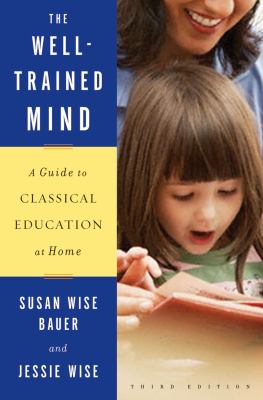
 As we gear up to start preschool in earnest, I’ve been revisiting some of the books that shaped my philosophy of home education. My favorite, The Well-Trained Mind, is a must-read for any parents considering homeschooling (or even supplementing after school). Jessie Wise and Susan Wise Bauer are a mom and daughter who started homeschooling back in the 70s because of what many of us personally experienced in school: “the effort to smooth out bumps by bringing well-prepared kids down to the level of the rest.” Instead, they did what was essentially classical education.
Wise laments that in most schools, “We no longer teach our children the process of memorization, organization, and expression–the tools by which the mind learns.” Enter the Trivium–grammar, logic, and rhetoric. I think their explanations are great, so I’ll quote for those who are unfamiliar with the concepts.:
The first years of schooling are called the “grammar stage”–not because you spend four years doing English, but because these are the years in which the building blocks for all other learning are laid, just as grammar is the foundation for language…Since children at this age actually find memorization fun, during this period education involves not self-expression and self-discovery, but rather the learning of facts: rules of phonics and spelling, rules of grammar, poems, the vocabulary of different languages, the stories of history and literature, descriptions of plants and animals and the human body, the facts of mathematics–the list goes on. This information makes up the “grammar” for the second stage of education.
…The second phase of classical education, the “logic stage,” is a time when the child begins to pay attention to cause and effect, to the relationships amoung the different fields of knowledge, to the way facts fit together into a logical framework…
…The final phase of classical education, the “rhetoric stage,” builds on the first two…The student of rhetoric applies the rules of logic learned in middle school to the foundational information learned in the early grades and expresses her conclusions in clear, forceful, elegant language.”
This make so much sense to me, based on my own parenting and teaching observations. Tommy LOVES to memorize, and it’s easy for him! (Anyone else remember the memory verses of our childhood better than those of our college years?) When I tried to get my middle school math and English students to logically organize their thoughts, they were completely frustrated–how can you do pre-algebra when you don’t have your multiplication tables memorized? And when I compare the essays written by my classically-trained online students to my own high school papers, I’m amazed at the rhetorical strength of my students–they write at a level I didn’t attain until college.
Classical education, the authors fully admit, is systematic and rigorous. Since our family believes our God is a God of order who blessed us with healthy minds, we believe that we can glorify Him by training our minds to do hard things. (Learning to read is hard–but so is learning to share, or learning to obey.)
I think that the biggest potential criticism skeptics have for the classical model is that parents will push their kids through too much material too quickly and not allow them to just be kids. Susan Wise Bauer gives a great answer to this in this interview: “Children move from grammar to logic stage thinking, and from logic to rhetoric stage thinking, at different times in different subjects. We should focus on this, rather than focusing on age or grade level.” The beauty of the classical model, done correctly, is that if my child is not developmentally ready to move on to pre-algebra, then I spend additional time on grammar-level math basics until she is ready. This might mean that we finish some things slower than a conventional homeschooler working through a conventional textbook. On the other hand, if we’ve been learning French vocab since preschool, our hope is that the kids will become fluent much sooner than those of us who started a foreign language in junior high. And the authors remind overzealous parents that grammar-level information is gained through systematic repetition, not hours and hours of drills every day. Don’t worry–my kids won’t be stuck inside reciting their Latin declensions all morning. We’ll be doing daily memory work along with a lot of free time outside, enjoying the beauty of God’s creation!
The book gives recommendations for curriculum and resources for every grade, Pre-K through 12th. I’ll be using it for years to come!
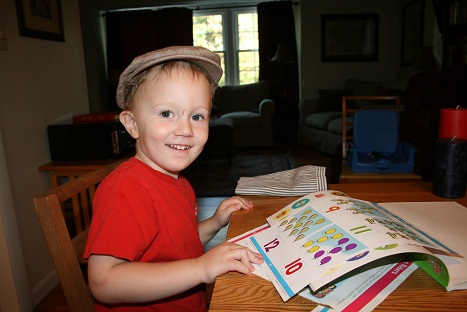
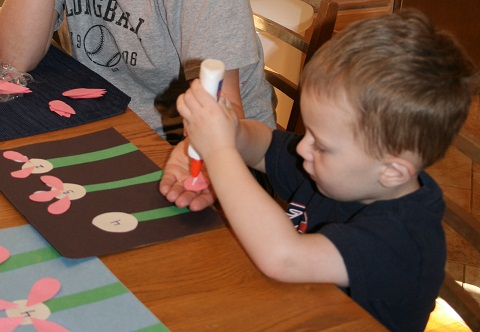
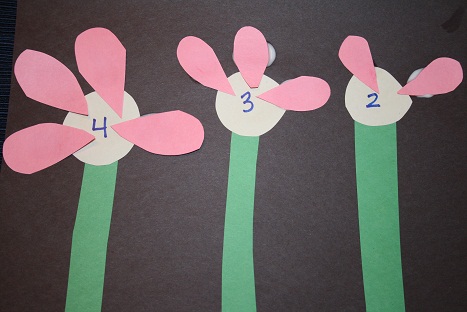
And just for fun, here’s Tommy, working on his grammar stage counting this morning…